
NXP BFU520R Silicon NPN Wideband Transistor: Datasheet Overview and Application Circuit Design
The NXP BFU520R is a high-performance silicon NPN transistor engineered specifically for very high-frequency applications. This transistor is a cornerstone in RF design, offering exceptional gain and linearity across a broad spectrum, making it an ideal choice for applications such as cellular infrastructure, UHF/SHF systems, and high-speed data links. This article provides a detailed overview of its key parameters from the datasheet and guides you through the design of a fundamental application circuit.
Datasheet Overview: Key Parameters
A thorough understanding of the BFU520R's datasheet is critical for effective circuit design. Several parameters stand out as particularly significant for RF engineers.
Transition Frequency (fT): This is arguably the most critical figure for high-speed transistors. The BFU520R boasts a typical fT of 9 GHz, indicating its excellent capability to amplify signals effectively into the microwave frequency range.
Noise Figure (NF): For receiver front-ends, low noise is paramount. With a noise figure of 1.4 dB typical at 900 MHz, this device ensures minimal degradation of weak signals, making it perfect for sensitive low-noise amplifiers (LNAs).
Gain (S-Parameters): The |S21|² parameter, representing power gain, is exceptionally high for such a wideband device. It offers approximately 19 dB of gain at 1.8 GHz, providing significant amplification in a single stage.
Output Power and Linearity: The 1 dB compression point (P1dB) and third-order intercept point (OIP3) are vital for power handling and linear performance. The BFU520R is designed to deliver good linearity, ensuring minimal distortion in amplified signals.
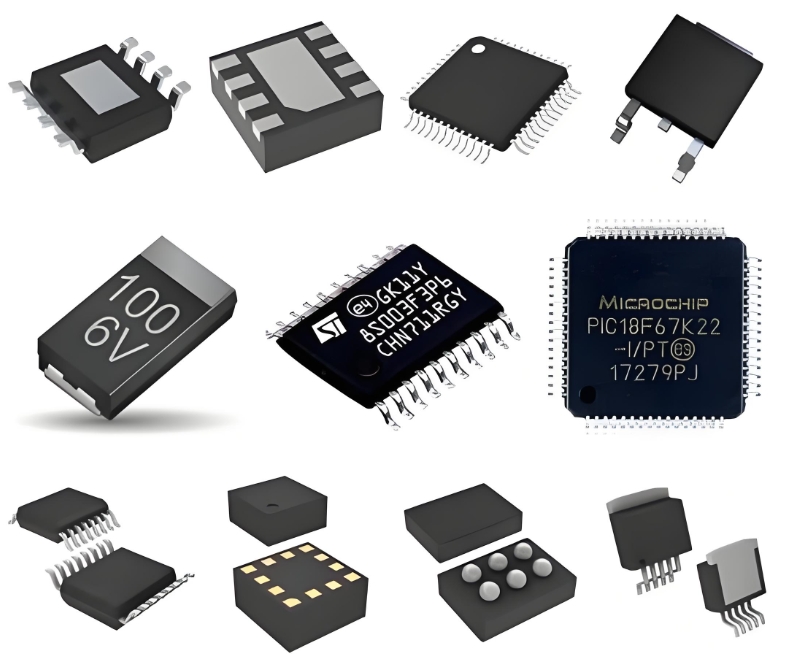
Package: It is housed in a SOT23-3 (R2) surface-mount package, which is preferred for its small footprint and excellent high-frequency characteristics, minimizing parasitic inductance and capacitance.
Application Circuit Design: A 1.8 GHz Low-Noise Amplifier (LNA)
Designing a stable LNA requires careful attention to biasing and impedance matching. Here is a step-by-step guide for a simple 1.8 GHz LNA design using the BFU520R.
1. DC Biasing: The foundation of any amplifier is a stable DC operating point. A common-emitter configuration with emitter feedback is often used to stabilize the bias point against temperature variations and transistor beta spread. A typical bias point for the BFU520R could be VCE = 5 V and IC = 10 mA. Resistors are selected to establish this quiescent point, often with a bypassed emitter resistor to maximize AC gain.
2. Stability Analysis: Before matching, it is crucial to ensure the transistor is unconditionally stable across the desired frequency band. This involves calculating stability factors (e.g., Rollett's K-factor) using the provided S-parameters. If necessary, a series base resistor or a shunt resistor can be added to improve stability.
3. Impedance Matching: For maximum power transfer and minimum noise, the input and output networks must be designed correctly.
Input Matching: The goal here is to minimize the noise figure. This involves matching the source impedance to the optimum noise impedance (Γopt) of the transistor, which is provided in the datasheet. This is often a conjugate match, not a simultaneous conjugate power match.
Output Matching: The output is typically matched for maximum gain and power transfer by conjugately matching the load impedance to the transistor's output impedance.
4. Circuit Topology: The final circuit will include:
DC blocking capacitors at the input and output.
RF chokes or bias tees to supply DC power to the collector while blocking RF signals from the power supply.
Microstrip lines or lumped-element components (inductors and capacitors) to form the matching networks on a PCB with a controlled impedance (e.g., 50-ohm lines).
Simulation with a proper RF tool (like ADS or SPICE with S-parameter models) is essential to verify gain, noise figure, stability, and bandwidth performance before fabrication.
ICGOOODFIND
The NXP BFU520R is an exceptionally versatile wideband transistor that excels in high-frequency amplification. Its standout combination of high transition frequency (9 GHz) and low noise figure (1.4 dB) makes it a superior choice for designing sensitive and powerful RF front-ends. By carefully applying its datasheet specifications to a stable biasing and impedance-matching framework, engineers can reliably implement robust LNAs and drivers for modern communication systems.
Keywords: Wideband Transistor, Low-Noise Amplifier (LNA), Noise Figure, Transition Frequency (fT), S-Parameters.

